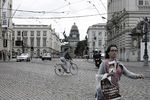
The policemen, in caps, were huddled on a hill at
the head of the valley. They were later to shoot a
handbag thief in what became briefly known on the
press center information screens as the incident de
rue saint Stevins. This caused some excitement among
the bored, waiting journalists. As one Dutch
journalist waiting with me later in the press bar
during one of the many interminable negotiating
sessions between ministers told me: "We don’t care
what happens – we don’t even care about the future
of Europe. We just want something to happen."
It was raining and the three sentinels flanked by
beetle like armoured cars stared you down as you
approached the blocked off rue de la loi, Europe’s
Whitehall, normally racing with traffic from the
rondpoint schuman, around which many Eu buildings
cluster, down towards the city centre. There was
anti riot fencing and, inside a large block of rue
de la loi in front of the Justus Lipsius building, a
sealed area accessible only to officials with their
black Mercedes and parked TV vans, with satellite
dishes on the roof and carrying the livery of
various TV stations.
You showed your special summit press pass – everyone
in the Eu always has pass around their neck, but
this was a dedicated one for the two day
intergovernment summit – and your bonjour was
greeted in kind if the policeman was a Bruxellois,
by a curt Hello in English if the policeman was
Flemish. They had brought reinforcements from afar
for this summit. In contrast, the EU buildings are
normally guarded only by an unarmed security guard
or two, who will stand in front of the apron of
steps of buildings unprotected by concrete blocks or
riot fencing. But then, it is not every day that
one of the victors of Iraq comes to pay a visit.
Then you passed through metal detectors into the
courtyard of the Justus Lipsius building, a giant
ten story marble cube devoted to where the real
power in Brussels lies: ministers f the nation
states who meet here every few months. There were
25 flags arranged in a circle today, because in six
months’ time ten new members states will join the 15
who are currently members. Clustered in small
groups, linked by shouted hellos of recognition
across the courtyard to new arrivals, carrying TV
equipment or laptop briefcases, stood men in
cashmere coats, talking into mobile phones.
You arrived inside, picked up a hundred-page
photocopies press review of pre summit articles in
the world’s press, and watched the screens
everywhere provided by the European Broadcasting
Union that monitored the various VIP areas and
summit press briefing rooms. There was nothing, and
so you repaired to your bar after reading in the
press guide booklet that refreshments and non
alcoholic drink were provided free.
Journalists privy to the secrets of the negotiations
noted that
politicians at these summits always negotiated under
signs
that said "Please do not smoke", but whose
organisers had anyway thoughtfully provided ashtrays
which were liberally used by various heads of
governments. "Which shows nation states’ attitudes
to European regulation." In the bar, the most
crowded area of the entire summit, were also signs
advising visitors not to smoke – if you could read
them through cigarette caused fug. Journalists were
taking trays with three or four coffees at a time,
piles high with baguette de fromage and croissants,
not always taken out on behalf of others.
Some journalists had already picked up their gifts
from the Italian presidency, a blue goody bag which,
it was soon revealed, contained a pannetoni cake and
a bottle of asti spumanti. "I am only taking this
because my wife wants it, "said one British hack
emerging from level 01. These bags went very
quickly, as evidenced by looking at how an edge had
been cut off journalist press cards who had already
been given their gift. In the course of about three
hours, the number of snipped cards went from none to
very high – maybe 70% - and yet you saw few hacks
actually carrying the bags. I left my pannetoni
behind the door; I drank the asti in the toilets.
Suddenly something happened: Signor Berlusconi, the
Italian president, and responsible for holding the
summit, had arrived. We crowded into the lobby, and
saw him pass: a small, grinning orange faced man
moving fast, flanked and surrounded by young
carabinieri quickstepping men in reservoir dog
suits. ("Oh, the Italians are always like that,"a
Polish stagiaire told me later.) This sense of purpose
suggested that the excitement built up in my mind, as
a first summit visitor, of seeing the policemen, the
armoured cars, the men in suits talking into mobiles,
would continue: the summit would be long, gruelling
(not a problem for me) but thrilling. One of the
shortest summits in history ended unspectacularly,
however, the next afternoon.
The British took the usual pragmatic view.
A single, unitary, closerr Europe would happen,
it would evolve - maybe, probably
perhaps over fifty years. but, with the incipient
defence treaty "Look at it!", Blair had set the ball
rolling. After they had experienced enlargement the
next step could commence. But put everything on hold.
Wait a year, for the experiences of enlargement to
happen. Above all - all of Europe moving, and
eventually coalescing, as one. And then he grinned.
And with a flash of bulbs his conference was over. You
basked in the British government's collective
sanguineness.
I waited outside the French room – attended by the
huge posse of clannish French journalists Chirac always
keeps in tow, lit in blue lights like a fashion show,
the French press conference was impossible to get
into – Katerina came out and
started talking volubly.
"He wants a two speed Europe. A closer one and an
outer one."
"Well he is not going to get it. We have got this
Nice treaty. They can’t."
"They want to and they will. They will still have
the Nice treaty but they will go beyond it."
We went to the Czech press room where I talked to
the Czech foreign minister. To my amazement he
confirmed that if a closer core Europe went ahead,
his country would be part of it.
"But what about world war 2, what about the Sudeten
Germans coming into country and chalking signs on
their old houses. ‘We are coming back’ What about
Blair saying nothing will change from Nice. Is
Chirac saying something different,. Is this a
dialogue of the deaf."
He cocked his head, smiled and nodded.
I went out to a free coffee dispenser with Katerina
who was smoking furiously.
"Why are you doing this given your history?"
"We are pro British but we have to go with the flow
because we are a small country. "
She binned her butt in the recycling receptacle for
plastic cups, which did actually look like a tall
ashtray. A caretaker of sorts who had been staring
all day in that general direction probably did his
first thing of the day – everyone in the expat
community says "Belgium is virtually communist" –
and told her not to do it, the thing could go on
fire. She apologised.
I went to the press room, milled around for an hour.
Then I looked for Katerina but she had left. I called her
number and she said she was on her way back to Prague, on
the president's plane.
I left the emptying building in the
drizzle and walked to Matonge, the African area,
where, amid shops selling yams and call shops
advertising rates to Rwanda for only 50 cents, I
dined alone.